

Our work speaks for itself.Resolving Decade-Long Basement Flooding in Hitchin
Flowcraft supported a customer in Hitchin, Hertfordshire to overcome a persistent flooding problem that had been ongoing for a decade. With our expert drainage services, we identified multiple root causes of this persistent flooding to design and construct a solution that would put an end to this costly problem.
The Challenge
Our customer’s wine cellar, situated beneath a large double garage and annexe, had been flooding repeatedly since the garage was built 10 years ago. Despite multiple contractors attempting to resolve the issue over the years, the fundamental problems had been consistently overlooked.
The key challenge was identifying the root cause of water ingress in a basement setting, where issues can remain hidden beneath ground level. With any basement work, the unknowns are significant – what lies beneath the surface isn't always visible until excavation begins.
The Route Cause
Through careful investigation, Flowcraft identified that rainwater ingress was the culprit. The double garage door, being exceptionally wide, faced directly into the prevailing wind. Every time it rained, water was blown against the door and ran down its surface. The critical flaw? Where the door met the floor, the ground sloped towards the building rather than away from it – a fundamental error that directed water straight into the garage and ultimately the basement below.
From the basement, it was clear that water was only entering from the area around the garage door at the front of the building. However, the team needed to determine if the door was the sole issue and, crucially, how the water was travelling from the door into the basement itself.
The Solution
Phase 1: Investigation
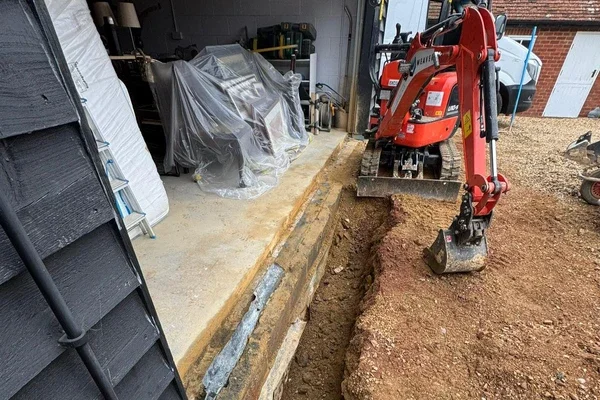
To ensure we can find the best solution to any groundworks problem, we will always work to find the exact cause/causes. During our comprehensive investigation, the Flowcraft team cut back and broke up the floor immediately along the front of the garage where the door meets the floor. Beneath the screed, we exposed the block and beam floor – the structural element forming the basement's roof. This revealed multiple points of water ingress.
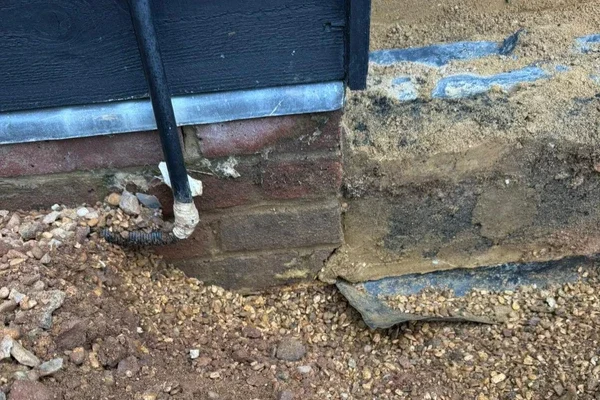
A trench was dug along the front of the garage to identify any additional entry points not visible from above ground. This excavation exposed various gaps and holes in the wall at the garage entrance, confirming the extent of the problem.
Phase 2: Designing and Constructing the Solution
Once the root causes had been confirmed, we developed a plan that would finally put an end to this persistent flooding.
There were a couple of key factors to consider:
Floor screed depth: Standard screed is typically 70mm thick. Creating an outward slope while maintaining sufficient depth to withstand vehicle weight was critical – too thin and the floor would crack under a car's weight, recreating the damp issues.
Complete waterproofing: Visible holes could be blocked, but even the smallest crack would allow water ingress. A thorough approach was essential.
Solution Details
Cut the floor back 100mm past the garage door into the garage
Cut the external wall down 100mm to create sufficient depth for a durable outward-sloping floor
Floor Modification
Damp-proof the wall 700mm below ground level, extending the waterproofing higher than the finished floor height
Apply damp-proofing to the exposed block and beam structure, so we left no stone unturned
Comprehensive Waterproofing
Backfill and compact the excavated area along the garage front with a carefully selected material that would:
Compact effectively without future movement
Allow water to permeate through
Not compromise the basement wall's integrity
Backfilling
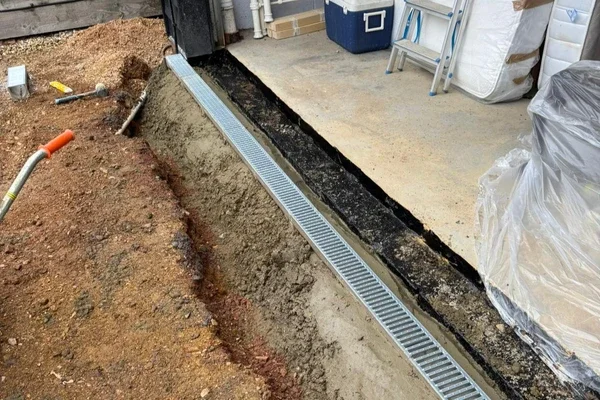
Install an ACO drain along the entire garage front to collect water running from the garage door
Precisely calculate the height of the ACO to form the lower outer edge of the slope away from the garage
Connect the ACO system into the site's surface water drainage system
ACO Drainage System
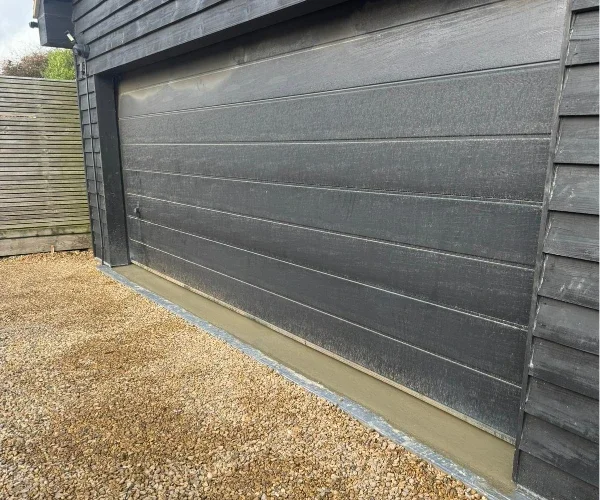
Replace screed with concrete for superior strength and longevity
While more challenging to finish and work with initially, concrete provides a more durable, longer-lasting result when executed correctly
Leverage Flowcraft's experience to achieve a professional finish
Concrete Slope Construction
Leave the property as though the team had never been there
Tidy and spruce up the driveway
Ensure complete client satisfaction
Site Restoration
This project required absolute precision and attention to not just detail - but quality - at every stage. The team had to balance structural integrity with effective water management, ensuring that the new slope was both functional and durable enough to withstand regular vehicle traffic.
The decision to use concrete rather than screed was crucial. While screed is easier to work with, we prioritised the long-term performance of the solution over short-term convenience.
The Result
The outcome speaks for itself. After a decade of persistent flooding problems and multiple failed attempts at resolution, the basement is now completely dry. The homeowner can now use their wine cellar without worrying it’s going to be left flooded and damp after heavy rain.
Do You Have A Drainage Problem That Needs Solving?
Whether you're dealing with a flooded basement, persistent water ingress, or drainage issues that others haven't been able to fix, Flowcraft has the expertise to identify the root cause and deliver a lasting solution.
Ultimately, our team ensures we can deliver efficient and durable solutions for your property’s needs.